
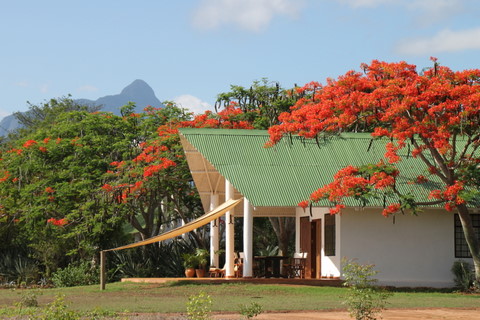

Mbuyuni Farm and Mbuyuni Farm Retreat
Kimango Farm Enterprises Ltd. operates Mbuyuni Farm close to the town of Morogoro and along the Ngerengere River. On the farm there is also Mbuyuni Farm Retreat (see loink below) and residential houses.
Mbuyuni Farm has been organically certified since 1992. Our certifying body is ECOCERT who inspects the farm every year and our certification is in accordance with European Union and Swiss regulations.
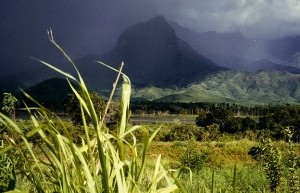 Mbuyuni Farm and the Ulugurus in the rainy season.
We produce and process about 25.000 kg of processed chili, moringa, and herbal teas annually and export most of it to Germany, Italy and Switzerland. A small quantity is sold locally under the “African Infusions” label. We also grow smaller quantities of pulses and cover crops and over the years have planted more than 30.000 trees on Mbuyuni Farm, indigenous as well as agroforestry species.
We employ 30 to 80 local staff, depending on the season. Most of our very dedicated team has been working with us for more than twenty years. For most of our permanent staff we provide housing on the farm and the others live in the nearby village of Kingolwira.
With an average annual rainfall of 600-700 mm, our production largely depends on irrigation, either with overhead sprinkle irrigation or drip irrigation. Both farms border rivers and have sufficient water rights.
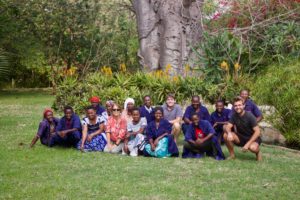
Our permanent staff on Mbuyuni Farm and at the Retreat.
Mbuyuni Farm
This farm is named after the many Baobab trees on the land (see “The Baobab Story”). When we started developing Mbuyuni Farm in 1992 the bushland was covered by sparse secondary vegetation after many years of charcoal making.
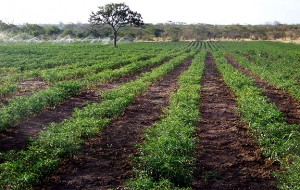
Chilis under irrigation on Mbuyuni Farm.
We prepared the land for cultivation, but left about 40% of the total area for regrowth of the natural bush and for reforestation. In 1997 we built a house on the farm and all of our processing and workshop facilities are also at this location.
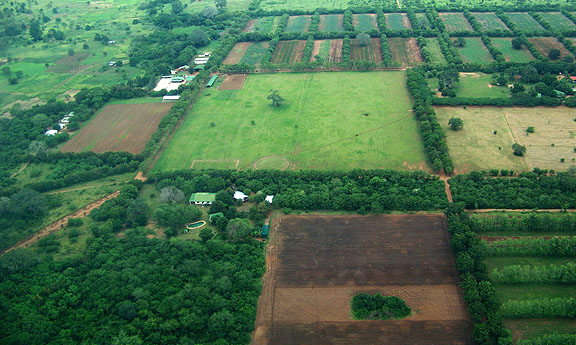
Aerial view of some fields and buildings on Mbuyuni Farm.